
Aamodt Settlement Agreement and Pojoaque Basin Regional Water System
Construction updates, including for County Road 84 in El Rancho, are on our Construction Updates page.
Water System Connection Information
Click on the following options or scroll down for more information about the Pojoaque Basin Regional Water System and how to connect.
What is the water system?
The Pojoaque Basin Regional Water System is a large infrastructure project currently underway in Northern New Mexico.
- It will provide reliable, safe drinking water to eligible Pueblo and non-Pueblo customers who opt in.
- Once operational, the system will deliver up to 2,500 acre-feet of water annually with capacity for expansion.
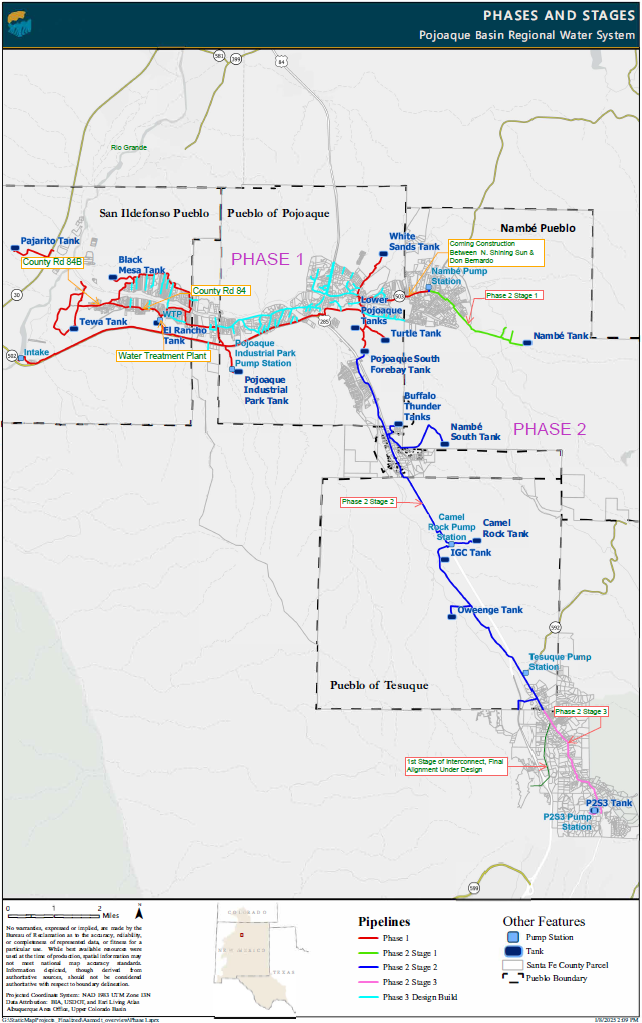
The Bureau of Reclamation is the lead on the project, responsible for design, construction, and budget. Construction is planned in three phases, with a projected completion of Phase 2 in 2029, and is one of Northern New Mexico’s largest infrastructure projects. A water treatment facility will treat water pulled from the Rio Grande and distribute it to tanks and residents through over 150 miles of planned waterlines.
The water system will be managed by the Pojoaque Basin Regional Water Authority. Santa Fe County may serve as the initial system operator. The system will be structured and operated to provide safe and reliable potable water to the residents of the Pojoaque Basin. The project will also provide water for fire suppression.
Did you know?
- You can keep your well for outdoor use AND connect your home to the water system for indoor use.
- If you are concerned about dwindling water supplies, doesn’t it make sense to have two sources of water for your home and property?
- See how to opt in below to find out more.
Who can opt in?
Eligible customers are:
- Parties of the Aamodt Settlement Agreement
And live in the corridors of
- NM-502
- NM-503
- 285 from Pojoaque to Tesuque
- Bishop’s Lodge Road
View the linked project map.
Why opt in?
The number one benefit of connecting to the system is to ensure your property has a reliable, safe drinking water supply.
The Water System utilizes the Rio Grande for 100% of its water supply. River water that has filtered down through the riverbed is withdrawn from two 30-foot deep Ranney Collector Wells on the bank of the Rio Grande and is pumped to the Water Treatment Plant in El Rancho. This project is helping the County reach its Climate Action Plan goals, by reducing the strain on the basin’s underground aquifer, and residents are helping by opting in.
Filing out your paperwork now helps the project planners decide where to put major waterlines. The location of the waterlines will depend on how many people opt in.
The project will add fire hydrants at intervals along the waterlines increasing fire protection, which is another benefit of opting in to make sure those lines go through your neighborhood.
The County will pay up to $10,000 to connect eligible residents to the water system—but you must opt in before Phase 3 begins.
If you opt in after Phase 3 begins in your area, you will have to pay the full cost to connect to the system, which is estimated to be between $8,000-$12,000, and you may not be able to connect after the designs have finalized. Phase 3 lines will be installed at different times throughout the entirety of the project. It's important to file the paperwork as soon as possible so you do not miss out.
Filing your Well Election Acceptance Form opting to connect to the Pojoaque Basin Regional Water System provides protection against possible priority water calls in the future during drought and water shortages.
This project is helping the County reach its Climate Action Plan goals, by reducing the strain on the underground aquifer, and residents are helping by opting in.
How to opt in?
To opt in, you must fill out a Well Election Acceptance Form. View the linked instructions for the form. This form contains four options.
- Option one is to fully connect to the water system and retire the well.
- Option two is to connect to the water system for indoor water use, and to keep the well operational for outdoor water use only—this is a great option for folks who irrigate gardens or orchards or for anyone who wishes to keep the well for outdoor use.
- Option three is to not connect at all.
- Option four is to connect to the water system upon transfer of the property.
A detailed description of these options can be found in the section of the Settlement Agreement regarding domestic wells, Section 3.1.7: Final Aamodt Settlement Agreement with Signatures (PDF) April 2012.
A chart that describes these options can be found on page 3.2 of the 2014 Aamodt Settlement Handouts.
The Water Master Rule was issued in September 2017.
Well Election Acceptance Forms must be filed with the U.S. District Court. To do so, you must file the original and three copies (one of which will be your Court-stamped copy) at the Clerk’s Office at one of the United States Courthouses which are located at this link.
File in person:
106 South Federal Place in Santa Fe
200 E. Griggs in Las Cruces
File in person or by mail:
333 Lomas Blvd. NW, Suite 270 in Albuquerque
Those individuals who file by mail will recieve a Court-stamped copy by including a preaddressed stamped envelope.
Who can help with the opt-in process?
County Project Manager
There is a Project Manager available to help with the process of opting into the water system.
For help, contact Santa Fe County Project Manager Scott Kaseman at 505-992-9887 or email SKaseman@SantaFeCountyNM.gov.
“It’s important for the County to know who is interested in connecting to the system now, to be considered for the final design, and we can help you through that process,” said Santa Fe County Project Manager Scott Kaseman.
Pojoaque Basin Regional Water System Call Center
To support effective communication with the community, Stampede Ventures, Inc. (SVI) has established a call center for the Pojoaque Basin Regional Water System (PBRWS) Project. The call center serves as a resource for project inquiries, construction updates, issue resolution, and service requests.
Contact Information
- Phone: (505) 629-0450
- Monday–Friday, 8:00 a.m.–5:00 p.m.
- Voicemails left after hours or on federal holidays will be returned the next business day.
- Email/Text: PBRWSinfo@bsnc.net
- Messages received after business hours will be addressed on the following business day.
The PBRWS Call Center is committed to providing professional, timely, and professional assistance to all members of the public seeking information regarding the project.
What if an easement is needed?
Most of the water pipeline will be built in exisiting right of way, but in some cases additional Permanent Utility Easements are necessary to construct the project. The County process of acquiring Permanent Utility Easements is described below.
Santa Fe County has contracted with SelectROW, Inc. to assist with acquiring necessary Permanent Utility Easements using the New Mexico Department of Transportation's Right of Way Acquisition Process as a guideline.
Initial Offer Packet
Your initial offer letter from SelectRow will explain how your property is impacted by the project.
It will include
- survey exhibits
- legal descriptions
- a waiver valuation estimate
- easement documents that need your signature.
Easement value is based on the waiver valuation method approved by the Bureau of Reclamation. Santa Fe County is using the high range of this method to determine values.
The initial offer packets are sent via certified mail with return receipt requested to ensure that the property owners reeive these important documents.
30-90 Days of Outreach and Discussion
Ideally, easement agreements will be signed and returned within 30 days. SelectROW's goal is to make contact with all property owners to answer any questions.
Unresolved Questions or Disputes
SelectROW will attempt to resolve property owner questions and disputes. The property owner may wish to negotiate the value offered or terms of the easement agreement.
If after 90 days, no resolution is in sight, then SelectROW will send a second letter called a Notice of Intent (NOI). The NOI urges the property owner to wrap up negotiations, gives the property owner a 25-day deadline to sign and return the easement agreement, and explains how the property owner can give their notice of intent to elect the 3-appraiser process.
If 25 days pass after receipt of the NOI, and the property owner does nothing, the Santa Fe County Commissioners may authorize a condemnation action. SelectROW will prepare a condemnation package and send it to the County to initiate a condemnation action.
BACKGROUND INFORMATION
Ongoing Adjudication
A water rights adjudication is a specialized court proceeding which is required by New Mexico law and is designed to determine and describe in a final decree all existing water rights in a stream system. The water rights in the Pojoaque Basin Stream System are being adjudicated in the case, State of New Mexico, ex rel. State Engineer v. Aamodt, et al. The case was filed in 1966, making it the oldest federal court case in the United States. The participants in the adjudication include all individual water users, local, state and federal governments, and the four Pueblos. The final judgment and decree was filed by the Court on July 14, 2017. The final decree incorporates the Pueblos’ partial final decree and other pertinent orders of the Court for the purpose of identifying, quantifying, and fully describing all water rights within the Pojoaque Basin Stream System.
For each water right established under New Mexico state law (as opposed to federal law), the decree describes the amount, purpose and place of use, source, and priority of the water right. In general, the amount of use of a water right is based on an owner’s historic beneficial use of water. The priority date of a water right under state law relates back to the first use of water, which in the case of acequia or ditch rights may have occurred several centuries ago.
When comparing two water rights, the one having the earlier priority date is called the “senior right,” and the one having the later date, the “junior right.” In times of water shortage, seniors have a right to a full supply and, if the exercise of a junior right interferes with the senior right, the senior may ask the Court or a water master to curtail the junior’s use, which is called a “priority call.” The actual curtailment is referred to as “priority administration” or “priority enforcement.” Because the date of their first use was before recorded history, the Pueblos have the most senior water rights in the Pojoaque Basin.
The Settlement Agreement identifies, describes, and limits the Pueblos’ water rights in the Basin. Importantly, it also limits the Pueblos’ right to seek curtailment of junior water uses of non-Pueblo well owners who become Settlement Parties. Documents filed with the Court in the Aamodt adjudication may be found at the Office of the State Engineer.
An overview of the Aamodt adjudication may be found at the University of New Mexico Utton Center newsletter Water Matters!
Handouts, forms, documents, and other links
- Well Election form
- Instructions for Well Election form
- El Rancho door flyer for 3-20-2026
- FAQs, March 3, 2025
- December 2024 Open House Presentation
- Santa Fe County Aamodt Related Resolutions
- PBRWS Quarterly Report
- Exhibit A - Bureau of Reclamation Quarterly Report
- Exhibit B - Bureau of Reclamation Baseline Schedule
For more information about the Regional Water System and the Aamodt Settlement Agreement, please contact:
Scott Kaseman, Project Manager Santa Fe County Public Works
505-992-9887
SKaseman@SantaFeCountyNM.gov