
Septic Systems
Septic Systems Education
Maintaining your Septic System
Do:
- Have your septic tank pumped regularly and checked for leaks and cracks.
- Conserve water to reduce the amount of wastewater that must be disposed of and treated by your system. Repairing any leaking facets and toilets will also help to conserve water.
- Discharge only biodegradable wastes into your system.
- Restrict garbage disposal use. Compost your garbage or put it in the trash.
- Divert down spouts and other surface water away from your drainfield**
- Keep your septic tank cover accessible for tank inspections and maintenance.
- Call a professional if you have problems.
- Keep a record of all maintenance work for the system.
- Ensure manholes are locked or heavy enough to prevent children from opening them.
- Use boiling water or a drain snake to open grease clogs. (caution, extreme heat can warp PVC pipes)
Don't:
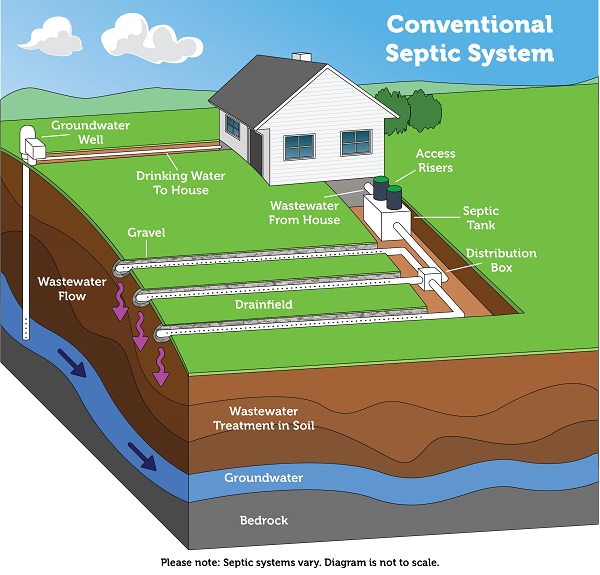
- Install a septic system near your water supply system (groundwater well).
- Build a septic system near a swimming pool or other surface water.
- Flush sanitary napkins, tampons, disposable diapers, condoms and other non-biodegradable products into your system.
- Dump solvents, oils, paint, thinners, disinfectants, pesticides or poisons down the drain. Such items can disrupt the treatment process and contaminate groundwater.
- Dig in your drain yard or building anything over it.
- Plant anything over your drainfield except grass.
- Drive over your drainfield or compact the soil.
- Use caustic drain openers for clogged drains.
- Allow water softener backwash to enter your septic tank.
- Dump grease or fats down the kitchen drain.
- Cover the drainfield with a hard surface, such as asphalt or concrete.
- Ever enter a septic tank.
- Smoke around a septic tank.
| Number of Persons in Household | |||||||
|---|---|---|---|---|---|---|---|
| Tank size (Gallons) | 1 | 2 | 3 | 4 | 5 | 6 | 7 |
| 1,000 | 12 years | 6 years | 4 years | 3 years | 2 years | 1 year | 1 year |
| 1,250 | 16 years | 7 years | 5 years | 3 years | 3 years | 2 years | 2 years |
| 1,500 | 19 years | 9 years | 6 years | 4 years | 3 years | 3 years | 2 years |
| 1,750 | 22 years | 11 years | 7 years | 5 years | 4 years | 3 years | 3 years |
| 2,000 | 25 years | 12 years | 8 years | 6 years | 4 years | 4 years | 3 years |
| 2,250 | 27 years | 14 years | 9 years | 7 years | 5 years | 4 years | 3 years |
| 2,500 | 32 years | 16 years | 10 years | 7 years | 6 years | 5 years | 4 years |
Note: Actual pumping needs depend on household usage and system conditions.
Regular pumping of a septic tank will extend the life of your wastewater system and protect your drainfield. The table below provides recommendations for approximately how often you should have your septic tank pumped. For example, a 1,000-gallon septic tank, which is used by two people should be pumped every six years. If there are eight people using a 1,000-gallon septic tank, it should be pumped every year. It is also a god idea to have a tank pumped just before a large gathering of people.
Additional Resources
Educational Materials
- pending
Other Resources
New Mexico Environment Department (NMED) - Onsite Wastewater/ Liquid Waste Bureau
The Onsite Wastewater Bureau ensures septic systems are adequately installed and maintained in a manner that is protective of public health and the environment.
New Mexico State University (NMSU)
Agricultural mechanics and engineering publications cover topics related to water quality, graywater, well disinfection, septic tank maintenance, farm safety, and irrigation water flow measurement.
The Cuidad Soil & Water Conservation District
The Ciudad Soil and Water Conservation District, a political subdivision of the state of New Mexico, promotes the conservation, improvement and responsible use of the natural resources on the rural and urban lands within its boundaries.
Environmental Protection Agency (EPA)
Encouraging homeowners, wastewater professionals, and state, tribal, and local officials to design and maintain effective systems to protect public health, preserve valuable water resources, and maintain economic vitality in their communities.
Amigos Bravos
Amigos Bravos is a statewide water conservation organization (based in Taos, NM) guided by social justice principles and dedicated to preserving and restoring the ecological and cultural integrity of New Mexico’s water and the communities that depend on it.